
Influence Factors of Comfort in The Post-Anesthesia Care Unit
Article Sidebar
Main Article Content
Abstract
Background: Many factors influence pain in patients during transferring from the recovery room to the ward. All of these factors can come from the patient, the environment, the patient's experience and family support. This study aimed to identify the factors that influence comfort in the post-anesthesia care unit.
Methods: The research method was observational explanatory, utilising a sample size of 284 post-surgery and anaesthesia patients who fit the inclusion criteria in the Post Anesthesia Care Unit (PACU) room at Prof. Dr Margono Soekarjo Purwokerto Hospital. The instruments used were the Brief Illness Perception Questionnaire (Brief IPQ), Generalized Anxiety Disorder 7-item (GAD-7), Caring Behavior Inventor-24, Questionnaire on generic skills, PPE-15 and The Picker Patient Experience Questionnaire are two instruments used to measure patient experiences. Partial Least Square Structural Equation Modeling (SEM PLS) was employed in the analysis.
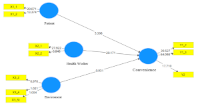
Results: The results revealed that health professionals and environmental factors affected comfort in developing PACT with a p-value of 0.000. At the same time, patient factors did not affect comfort in developing PACT, with a p-value of 0.344. This was due to several factors that influence patient factors such as the perception and anxiety of respondents after surgery and anaesthesia. After surgery, the patient's perception was primarily positive, and most anxiety were mild.
Conclusion: There was an effect of health professionals and environmental factors on comfort in developing the PACT model, but there was no effect of patient factors and the environment on comfort in developing the PACT model
Downloads
Article Details
Section

This work is licensed under a Creative Commons Attribution-NonCommercial-ShareAlike 4.0 International License.
The Journal is owned, published and copyrighted by the Nigerian Medical Association, River state Branch. The copyright of papers published are vested in the journal and the publisher. In line with our open access policy and the Creative Commons Attribution License policy authors are allowed to share their work with an acknowledgement of the work's authorship and initial publication in this journal.
This is an open access journal which means that all content is freely available without charge to the user or his/her institution. Users are allowed to read, download, copy, distribute, print, search, or link to the full texts of the articles in this journal without asking prior permission from the publisher or the author.
The use of general descriptive names, trade names, trademarks, and so forth in this publication, even if not specifically identified, does not imply that these names are not protected by the relevant laws and regulations. While the advice and information in this journal are believed to be true and accurate on the date of its going to press, neither the authors, the editors, nor the publisher can accept any legal responsibility for any errors or omissions that may be made. The publisher makes no warranty, express or implied, with respect to the material contained herein.
TNHJ also supports open access archiving of articles published in the journal after three months of publication. Authors are permitted and encouraged to post their work online (e.g, in institutional repositories or on their website) within the stated period, as it can lead to productive exchanges, as well as earlier and greater citation of published work (See The Effect of Open Access). All requests for permission for open access archiving outside this period should be sent to the editor via email to editor@tnhjph.com.
How to Cite
References
1. Degu S, Kejela S, Zeleke HT. Perioperative mortality of emergency and elective surgical patients in a low-income country: a single institution experience. Perioper Med. 2023;12(1). doi:10.1186/s13741-023-00341-z
2. Pearse RM, Moreno RP, Bauer P, et al. Mortality after surgery in Europe: A 7 day cohort study. Lancet. 2012;380(9847):1059-1065. doi:10.1016/S0140-6736(12)61148-9
3. BILGIN E, ÖKTEN AI. Post-operative pain management for single-level lumbar disc herniation surgery: A comparison of betamethasone, ibuprofen, and pregabalin. Agri. 2021;33(2):89-95. doi:10.14744/agri.2020.82335
4. Osorio W, Ceballos C, Moyano J. Effectiveness of acute post-operative pain management by the acute pain service. Cirugía y Cir (English Ed. 2023;90(2). doi:10.24875/cirue.m21000478
5. Koeppe J, Stolberg-Stolberg J, Rischen R, et al. Increased complication rates of salvage reverse total shoulder arthroplasty (RTSA) after failed locked plate fixation compared with primary RTSA in the treatment of proximal humeral fractures in elderly patients. J Shoulder Elb Surg. 2023;32(8):1574-1583. doi:10.1016/j.jse.2022.12.020
6. Horacek R, Krnacova B, Prasko J, Latalova K. Delirium as a complication of the surgical intensive care. Neuropsychiatr Dis Treat. 2016;12:2425-2434. doi:10.2147/NDT.S115800
7. Huda N, Shaw MK, Chang HJ, Putri ST, Pranata S. The mediating role of coping styles in the relationship between fear of COVID ‑ 19 and mental health problems : a cross ‑ sectional study among nurses. BMC Public Health. Published online 2024:4-11. doi:10.1186/s12889-024-17863-w
8. Huda N, Nurchayati S, Pranata S, bin Sansuwito T. Religion and Spirituality in Coping with Cancer: A Literature Review. Malaysian J Nurs. 2022;14(2):151-156. doi:10.31674/mjn.2022.v14i02.025
9. Seese L, Sultan I, Gleason TG, et al. The Impact of Major Postoperative Complications on Long-Term Survival After Cardiac Surgery. Ann Thorac Surg. 2020;110(1):128-135. doi:10.1016/j.athoracsur.2019.09.100
10. Gonzalez-Baz MD, Pacheco Del Cerro E, Ferrer-Ferrándiz E, et al. Psychometric validation of the Kolcaba General Comfort Questionnaire in critically ill patients. Aust Crit care Off J Confed Aust Crit Care Nurses. 2023;36(6):1025-1034. doi:10.1016/j.aucc.2022.12.013
11. Liu B, Liu S, Wang B, et al. Effectiveness and safety of implementing an enhanced patient comfort programme for elective neurosurgical patients: a randomised controlled trial protocol. BMJ Open. 2023;13(4):e063534. doi:10.1136/bmjopen-2022-063534
12. Burgess DJ, Hagel Campbell EM, Branson M, et al. Exploring Gender Differences in Veterans in a Secondary Analysis of a Randomized Controlled Trial of Mindfulness for Chronic Pain. Women’s Heal Reports. 2024;5(1):82-92. doi:10.1089/whr.2023.0086
13. Pranata S. Physical and psychosocial variables need to be prioritized in diabetes care : a special communication about comfort. 2021;3(3):2-5.
14. Bayissa BB, Mummud M, Miressa F, Fekadu G. Postoperative Complications and Associated Factors Among Surgical Patients Treated at a Tertiary Hospital, Eastern Ethiopia: A Prospective Cohort Study. Open Access Surg. 2021;Volume 14:37-46. doi:10.2147/oas.s320506
15. Nuraini T, Andrijono A, Irawaty D, Umar J, Gayatri D. Spirituality-focused palliative care to improve Indonesian breast cancer patient comfort. Indian J Palliat Care. 2018;24(2):196-201. doi:10.4103/IJPC.IJPC_5_18
16. Englid MB, Jirwe M, Conte H. Perioperative Comfort and Discomfort: Transitioning From Epidural to Oral Pain Treatment After Pancreas Surgery: A Qualitative Study. J Perianesthesia Nurs. 2023;38(3):414-420.e1. doi:10.1016/j.jopan.2022.06.007
17. Pinto N, Abreu MJ, Catarino A. Wear trials about comfort on sport compression socks. J Biomimetics, Biomater Biomed Eng. 2022;57:77-88. doi:10.4028/p-ci8p3o
18. YAMAN AKTAŞ Y, KARABULUT N. Quality of Perioperative Nursing Care and Comfort among Neurosurgery Patients: A Cross-sectional Study. Clin Exp Heal Sci. Published online October 2020. doi:10.33808/clinexphealthsci.525635
19. Zaybak A, Çevik K. Yoğun bakım Ünitesindeki stresörlerin hasta ve hemşireler tarafından algılanması. J Med Surg Intensive Care Med. 2015;6(1):4-9. doi:10.5152/dcbybd.2015.652
20. Gray E, Erickson M, Bindler R, Eti DU, Wilson M. Experiencing COMFORT: Perceptions of Virtually-delivered Nonpharmacologic Therapies in Adults Prescribed Opioids for Chronic Pain. Pain Manag Nurs. 2023;24(4):469-476. doi:10.1016/j.pmn.2023.04.002
21. Mei G, Jiang W, Xu W, et al. Effect of comfort care on pain degree and nursing satisfaction in patients undergoing kidney stone surgery. Am J Transl Res. 2021;13(10):11993-11998.
22. Tian Y. A review on factors related to patient comfort experience in hospitals. J Heal Popul Nutr. 2023;42(1). doi:10.1186/s41043-023-00465-4
23. Yous ML, Boamah SA, Hunter P V., et al. Exploring the factors influencing meaningful engagement of persons living with advanced dementia through the Namaste Care Program: a qualitative descriptive study. Palliat Care Soc Pract. 2023;17:26323524231165320. doi:10.1177/26323524231165319
24. Shipp GM, Weatherspoon LJ, Norman GS, Alexander GL, Kelleher D, Kerver JM. Understanding Factors Influencing Breastfeeding Outcomes in a Sample of African American Women. Matern Child Health J. 2022;26(4):853-862. doi:10.1007/s10995-021-03261-w
25. Fan YL, Qian JL, Ma EL, Stricker PA, Zuo YX. Incidence and Risk Factors of Postoperative Severe Discomfort After Elective Surgery Under General Anesthesia: A Prospective Observational Study. J PeriAnesthesia Nurs. 2021;36(3):253-261. doi:10.1016/J.JOPAN.2020.10.006