
A rare case of Aplasia Cutis Congenita type VII in a Nigerian newborn: Diagnostic and psychological challenges in a low-resource setting
Article Sidebar
Main Article Content
Abstract
Background: Aplasia cutis congenita (ACC) is a rare congenital anomaly characterized by the localized absence of skin. Type VII ACC, which predominantly affects the lower limbs, is extremely rare and usually not associated with blistering, making diagnosis challenging.
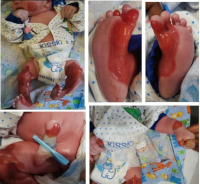
Case presentation: This reports a term male neonate delivered by caesarean section with normal APGAR scores and anthropometric parameters, who presented with bilaterally symmetrical areas of absent skin over both lower limbs and several smaller lesions elsewhere. The denuded areas were covered by translucent membranes with visible vasculature, and the calves appeared swollen and hypoplastic. No blisters or mucosal lesions were observed. The infant was markedly irritable on touch. Supportive wound care with warm saline-soaked gauze and breastfeeding were initiated, but the father declined referral and further investigations due to financial and cultural constraints. Partial epithelialization occurred within 24 hours, and minor lesions healed rapidly. The family discharged themselves after three days; the baby died at home 11 days later.
Conclusion: This case highlights the diagnostic dilemma of extensive, symmetrical, non-blistering ACC Type VII and the challenges of managing rare congenital conditions in low-resource settings. While differential diagnoses include severe forms of epidermolysis bullosa and vascular-disruption variants, definitive classification requires histopathologic or molecular studies. Early counselling and attention to sociocultural barriers are vital to improve outcomes.
Downloads
Article Details
Section

This work is licensed under a Creative Commons Attribution-NonCommercial-ShareAlike 4.0 International License.
The Journal is owned, published and copyrighted by the Nigerian Medical Association, River state Branch. The copyright of papers published are vested in the journal and the publisher. In line with our open access policy and the Creative Commons Attribution License policy authors are allowed to share their work with an acknowledgement of the work's authorship and initial publication in this journal.
This is an open access journal which means that all content is freely available without charge to the user or his/her institution. Users are allowed to read, download, copy, distribute, print, search, or link to the full texts of the articles in this journal without asking prior permission from the publisher or the author.
The use of general descriptive names, trade names, trademarks, and so forth in this publication, even if not specifically identified, does not imply that these names are not protected by the relevant laws and regulations. While the advice and information in this journal are believed to be true and accurate on the date of its going to press, neither the authors, the editors, nor the publisher can accept any legal responsibility for any errors or omissions that may be made. The publisher makes no warranty, express or implied, with respect to the material contained herein.
TNHJ also supports open access archiving of articles published in the journal after three months of publication. Authors are permitted and encouraged to post their work online (e.g, in institutional repositories or on their website) within the stated period, as it can lead to productive exchanges, as well as earlier and greater citation of published work (See The Effect of Open Access). All requests for permission for open access archiving outside this period should be sent to the editor via email to editor@tnhjph.com.
How to Cite
References
1. Higgins C, Price A, Craig S. Aplasia cutis congenita. BMJ Case Rep. 2022;15(9):e251533. DOI: https://doi.org/10.1136/bcr-2022-251533.
2. Cordon M. Extrait d'une letter au sujet de trios enfants de la meme mere nes avec partie des extremites denuee de peau. J Med Chir Pharmacie. 1767;26:556-57.
3. Silberstein E, Pagkalos VA, Landau D, Berezovsky AB, Krieger Y, Shoham Y, et al. Aplasia cutis congenita: clinical management and a new classification system. Plast Reconstr Surg. 2014;134(5):766e-74e. DOI: 10.1097/PRS.0000000000000638.
4. Frieden IJ. Aplasia cutis congenita: a clinical review and proposal for classification. J Am Acad Dermatol. 1986;14(4):646-60. DOI: 10.1016/s0190-9622(86)70082-0.
5. Usman SA, Taslim LO, Habib MI, Lily MT, Kudirat OE, Lamidi AI. Aplasia cutis congenita of extremities (group VII): case report from North-Western Nigeria. Sudan J Paediatr. 2023;23(2):234-38. DOI: 10.24911/SJP.106-1670856184.
6. Quach KT, Wind C, van Mierlo K, Vos LE. Aplasia cutis congenita type VII of the lower extremity: a favourable disease course with minimal conservative treatment. BMJ Case Rep. 2024;17(4):e257572. DOI: 10.1136/bcr-2023-257572.
7. Mava Y, Yakubu A. Aplasia cutis congenita in a Nigerian child: a case report. Niger J Paediatr. 2017;44(1):32-34. (https://www.njpaediatrics.com/index.php/njp/article/view/173).
8. Li G, Zhang A, Yang S, Lin N, Fang X. Type VII Aplasia cutis congenita in neonates related to maternal HBV infection? Case report and literature review. Clin Cosmet Investig Dermatol. 2023:499-504. DOI: 10.2147/CCID.S396071.
9. Brackenrich J, Saleh HM, Brown A. Aplasia cutis congenita. StatPearls [Internet]. Treasure Island (FL): StatPearls Publishing; 2023.
10. Pongmee P, Wittayakornrerk S, Lekwuttikarn R, Pakdeeto S, Watcharakuldilok P, Prempunpong C, et al. Epidermolysis bullosa with congenital absence of skin: congenital corneal cloudiness and esophagogastric obstruction including extended genotypic spectrum of PLEC, LAMC2, ITGB4 and COL7A1. Front Genet. 2022;13:847150. DOI: 10.3389/fgene.2022.847150.
11. Ochigbo SO, Kingsley AI, Antigha CE, Jacob UJ. Aplasia cutis congenita associated with epidermolysis bullosa in a Nigerian child. Int J Res Dermatol. 2018;4(1):80-82. DOI: https://doi.org/10.18203/issn.2455-4529.IntJResDermatol20180144.
12. Ehighibe AP, Abubakar AI, Mshelbwala PM. A case of aplasia cutis type VI (Bart’s syndrome) at University of Abuja Teaching Hospital Gwagwalada, Abuja, Nigeria. Niger J Plast Surg. 2020;16(2):89-91. DOI: 10.4103/njps.njps_10_19.
13. Mukhtar-Yola M, Mshelia L, Mairami AB, Otuneye AT, Yawe ET, Igoche P, et al. Aplasia cutis congenita: a report of two cases from National Hospital Abuja, Nigeria and review of the literature. Pan Afr Med J. 2020;36:291-99. DOI: 10.11604/pamj.2020.36.291.24523.
14. Ogundipe K, Kadiri I, Oluwayemi I, Ogundare E, Wash Y, Wuraola I. Aplasia cutis congenita: dilemma of management in a resource-limited scenario. J Surg. 2020;5:1274. DOI: 10.29011/2575-9760.001274.
15. Chibuzor OP, Adeniyi AS, Enimi OJ, Dennis A, Paul DD, Ebiogbo OS, et al. Aplasia Cutis Congenita: Uncommon finding of two cases occuring in one patient in two successive deliveries. Yen Med J. 2019;1(1):61-65.
16. Oyinwola OI, Adebiyi LO, Ozioko OH, Adegbenro AP. Clinical features of Adams Oliver syndrome in a rural hospital. J Case Rep Sci Images. 2025;7(1):138-40. DOI: https://www.doi.org/10.22271/27080056.2025.v7.i1c.124.
17. Getnet A, Figa Z, Tarekegn D, Gido R, Aschalew Tesfa G. Beliefs and perceptions towards congenital anomalies in Dilla town, Gedeo Zone, Southern Ethiopia; a qualitative study. BMC Pediatr. 2025;25(1):23. DOI: https://doi.org/10.1186/s12887-024-05257-1.
18. Oginni FO, Asuku ME, Oladele AO, Obuekwe ON, Nnabuko RE. Knowledge and cultural beliefs about the etiology and management of orofacial clefts in Nigeria's major ethnic groups. Cleft Palate Craniofac J. 2010;47(4):327-34. DOI: 10.1597/07-085.1.
19. Kimotho SG, Macharia FN. Social stigma and cultural beliefs associated with cleft lip and/or palate: parental perceptions of their experience in Kenya. Humanit Soc Sci Commun. 2020;7(1):181. DOI: https://doi.org/10.1057/s41599-020-00677-7.
20. Taye M. Parents' perceived knowledge and beliefs on congenital malformations and their causes in the Amhara region, Ethiopia. A qualitative study. PLoS One. 2021;16(11):e0257846. DOI: 10.1371/journal.pone.0257846.
21. von der Lippe C, Neteland I, Feragen KB. Children with a rare congenital genetic disorder: a systematic review of parent experiences. Orphanet J Rare Dis. 2022;17(1):375. DOI: 10.1186/s13023-022-02525-0.